
La LLorona
The folk legend of La Llorona occupies a deeply rooted and emotionally charged space within the cultural imagination of Mexico and much of continental America. More than a simple ghost story, it is a narrative that blends Anahuacan cosmology, colonial trauma, gender expectations, and moral instruction into a haunting figure that continues to resonate across generations.
7/25/20263 min read
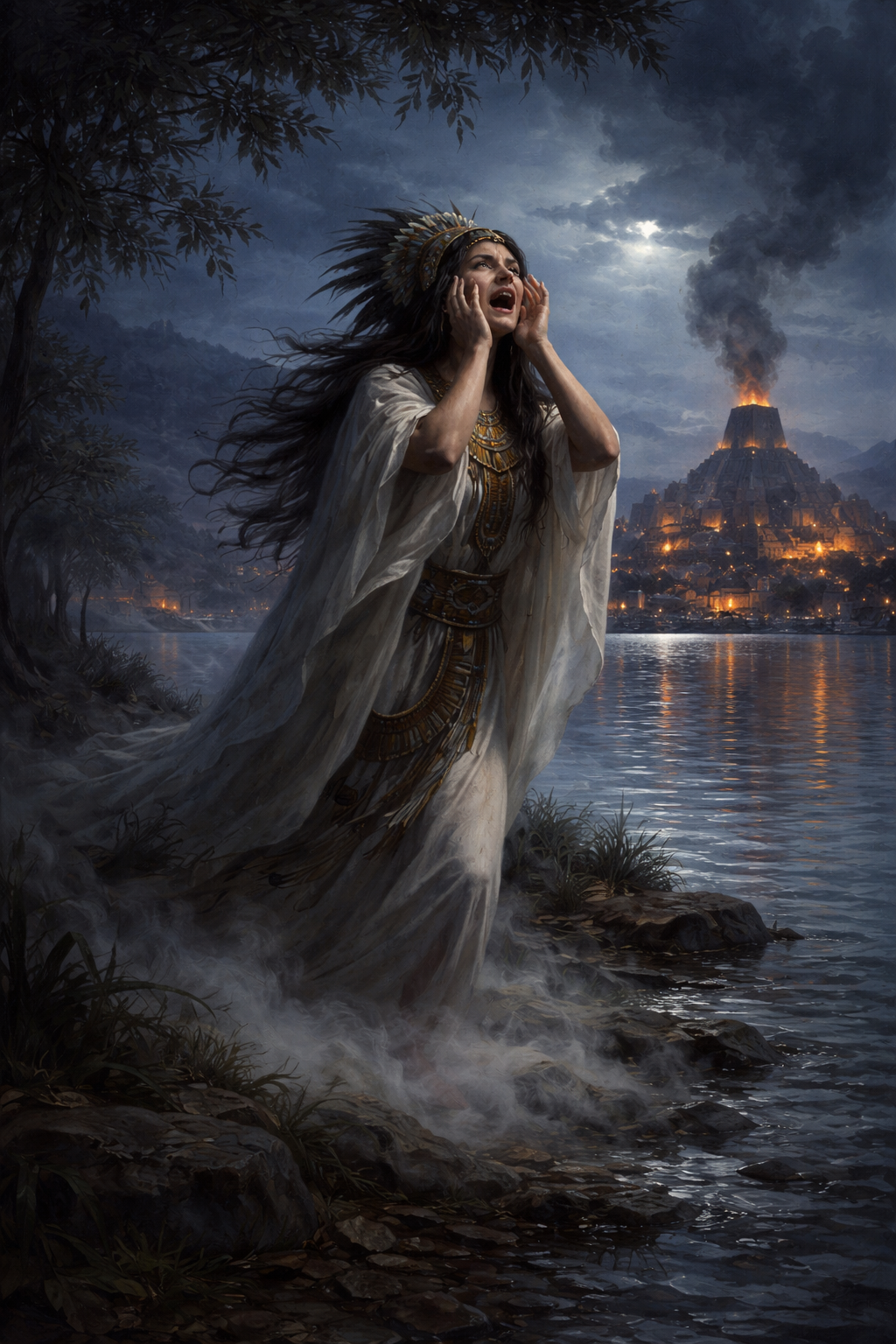
The folk legend of La Llorona occupies a deeply rooted and emotionally charged space within the cultural imagination of Mexico and much of continental America. More than a simple ghost story, it is a narrative that blends Anahuacan cosmology, colonial trauma, gender expectations, and moral instruction into a haunting figure that continues to resonate across generations. The tale is most commonly told as the story of a woman who, in a moment of despair or rage, drowns her children in a river and is thereafter condemned to wander the earth, eternally mourning her loss with her chilling cry: “¡Ay, mis hijos!” This lament, echoing through riversides, rural paths, and even urban outskirts, has become one of the most recognizable auditory symbols in Mexican folklore.
At its core, La Llorona is a figure of contradiction, both victim and perpetrator, human and supernatural, maternal and destructive. This duality is part of what gives the legend its enduring psychological power. One of the earliest antecedents of the figure of La Llorona appears on native testimonies about the omens preceding the fall of Mexico-Tenochtitlan. Among these accounts stands out the apparition of a spectral woman who wandered at night crying and lamenting with a blood-curdling wail: “Oh my children, we must go far away!” or “Where shall I take you?”. This figure is commonly associated with Cihuacóatl, a deity linked to motherhood and war, whose cries were interpreted as an omen of imminent destruction. Unlike the later colonial and popular version of La Llorona—focused on individual guilt and moral punishment—this Anahuacan manifestation carries a collective and prophetic character: she does not weep for children she herself lost through a tragic act, but for the fate of an entire people facing doom. In this sense, the nocturnal lament can be understood as a deep root of the myth, where maternal sorrow becomes a metaphor for the collapse of an entire world.
In other versions, the woman is betrayed by a lover or abandoned by a man of higher social status, often a Spaniard during colonial times. Her act of infanticide, while horrifying, is framed within a context of emotional devastation and social marginalization. In this sense, La Llorona can be interpreted as a reflection of the historical conditions of colonial Mexico, where indigenous and mestiza women were frequently subjected to exploitation, abandonment, and rigid moral expectations. Her eternal punishment, wandering in search of her lost children, mirrors a broader cultural anxiety about motherhood, guilt, and the consequences of transgression.
Beyond its historical and mythological dimensions, La Llorona serves a clear social function. Traditionally, the story has been used as a cautionary tale, particularly for children. Parents warn their sons and daughters not to wander near rivers at night, lest La Llorona mistake them for her own and carry them away. In this way, the legend operates as a form of communal discipline, reinforcing boundaries between safety and danger, home and wilderness, obedience and disobedience. However, its role is not limited to childhood instruction. For adults, the story often carries deeper symbolic meanings related to regret, loss, and the irreversible consequences of one’s actions.
In contemporary culture, La Llorona has transcended oral tradition to become a powerful symbol in literature, film, and art. She appears in horror cinema, feminist reinterpretations, and political discourse, often reimagined as a figure of resistance or a metaphor for historical grief. In some modern readings, La Llorona embodies the collective sorrow of a nation marked by conquest, inequality, and violence. Her endless mourning becomes not just personal, but cultural, a cry that echoes the unresolved traumas of history.
Ultimately, the enduring presence of La Llorona speaks to the human need to give form to sorrow and guilt. She is not merely a ghost that haunts rivers; she is an emotional archetype that inhabits the spaces between love and loss, memory and punishment. Her story persists because it is adaptable, capable of absorbing new meanings while retaining its haunting core. Whether whispered as a warning, portrayed as a monster, or reinterpreted as a tragic heroine, La Llorona continues to walk the cultural landscape forever searching, forever crying, and forever reminding us of the fragile line between devotion and despair.